
Reproductive Health and Heart Disease: identifying adverse reproductive health as an emerging risk factor for heart disease
Women experience disproportionately poor cardiovascular outcomes, especially in low-income settings, where the burden is often greatest. While factors such as early menopause and adverse pregnancy outcomes are well-established risk factors for cardiovascular disease (CVD) in high-income countries, their impact remains underexplored in low-resource settings.
In Haiti, the estimated CVD mortality rate among women is 451.2 deaths per 100,000, the highest in the Latin American and Caribbean region, more than four times the rate in the United States (101.5 deaths per 100,000). To address this critical knowledge gap, we introduced a reproductive health questionnaire in 2023, adapted from the National Health and Nutrition Examination Survey (NHANES) developed by the Centers for Disease Control and Prevention (CDC). This effort aims to better understand how reproductive health factors influence cardiovascular outcomes among women in Haiti.
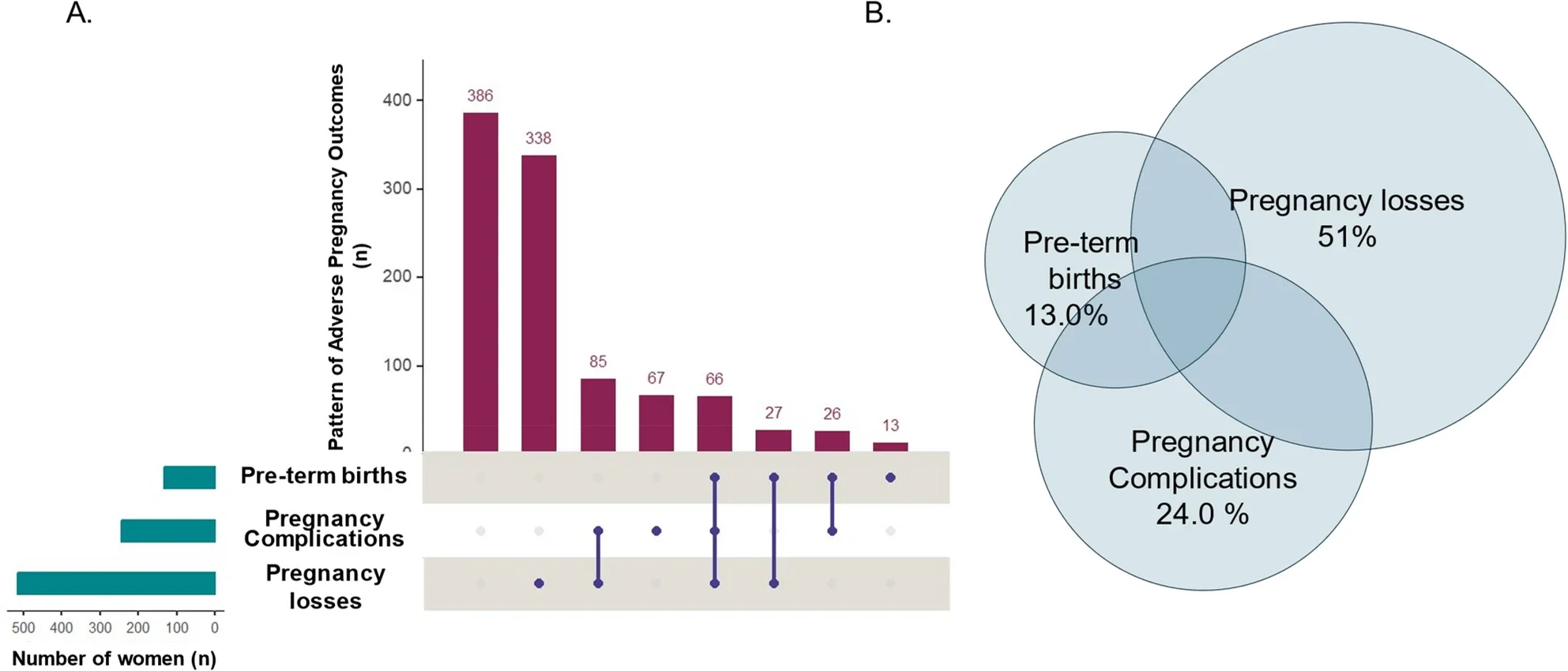
Adverse Pregnancy Outcomes: Individual burden and co-occurrence of key adverse pregnancy outcomes. A Counts of women with one or more reported adverse pregnancy outcomes. B Visual summary of co-occurrence of adverse pregnancy outcomes n: 623 (Alexandre et al., 2025).
Led by Dr. Wheytnie Alexandre, our research to date has revealed a high prevalence (66%) of adverse pregnancy outcomes (APOs), including pregnancy loss and hypertensive disorders of pregnancy, among Haitian women. Women with a history of APOs have a 37% higher prevalence of cardiovascular disease driven primarily by heart failure, even after accounting for age, hypertension, and other risk factors (Alexandre et al., 2025). We plan to further study the relationship between APO and incident hypertension and CVD. Beyond pregnancy outcomes, we are expanding our research to explore biological markers of reproductive health, such as anti-Müllerian hormone (AMH), using biobanked samples. This work will help deepen our understanding of how reproductive health influences long-term cardiovascular risk.